
Guide
Hytale NPCs: Behaviors, Factions, and Interactions Explained
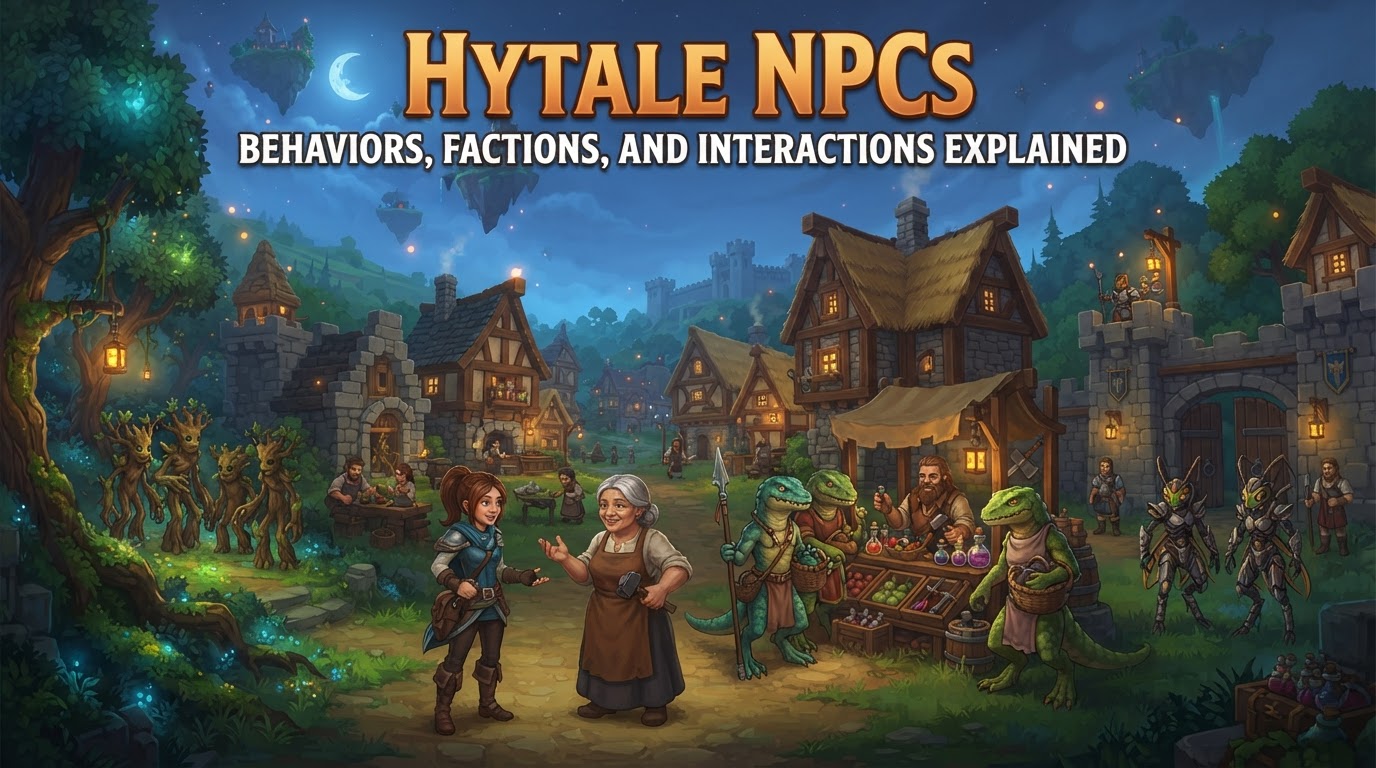
Hytale’s Non-Player Characters (NPCs) are governed by a sophisticated, data-driven AI system designed for dynamic behaviors, complex interactions, and extensive moddability. This system allows for a living, breathing world where NPCs react to players, their environment, and each other, forming societies with distinct reputations and ecological roles.
Hytale NPC Mechanics: The Core AI System
At its heart, Hytale’s NPC system is a behavior-driven framework built around a hierarchical state machine architecture. This design is highly data-driven, meaning much of an NPC’s personality and actions are defined through configuration files, making it accessible for modders even without programming knowledge.
Core Components of NPC AI
- Roles: Every NPC possesses a “Role” that encapsulates its entire identity. This includes its visual appearance, health, combat statistics, inventory, movement physics, default attitudes towards players and other NPCs, and its complete behavior configuration. Roles can be Abstract (templates), Generic, or Variant (specific variations of existing NPCs).
- Sensors: These are the NPC’s “eyes and ears,” detecting various conditions in the game world. Sensors can identify the presence of a player, register damage taken, or recognize specific in-game events. The information gathered by sensors is fed into the NPC’s “Blackboard,” which acts as its memory.
- Actions: Actions are the executable behaviors an NPC performs. They are triggered by conditions detected by sensors. Actions range widely, from combat maneuvers (attacks, special abilities) and movement (pathfinding, teleportation) to interaction actions (opening trade interfaces, dialogue), state management, and even world manipulation (placing or destroying blocks).
- Motions: This component handles the physical movements of an NPC, including body and head movements. It manages locomotion, determines where the NPC is looking, handles collision avoidance, and dictates how the NPC responds to knockback.
- State Machine: This critical component manages the transitions between different behavioral states an NPC can be in. For example, an NPC might transition from an Idle state to a Combat state, or from Fleeing to Patrolling, based on environmental cues and internal logic.
- Data-Driven Configuration: A cornerstone of Hytale’s moddability, NPC behaviors are defined using JSON configuration files. This allows modders to create incredibly complex AI routines and unique NPC personalities without needing to write custom code.
Dynamic Behaviors and Ecological Interactions
Hytale’s NPCs exhibit a wide array of behaviors, interacting not only with players but also extensively with their environment and each other, creating a vibrant ecosystem.
NPC Hostility Levels
- Passive: These NPCs typically ignore players under normal circumstances. If attacked, their primary response is to flee (e.g., most livestock, small critters).
- Neutral: Neutral NPCs tolerate a player’s presence up to a certain point. However, they will become aggressive and attack if provoked, if a player trespasses into their territory, or if certain conditions are met (e.g., some wild animals, specific faction members).
- Hostile: Hostile NPCs will attack players on sight. These generally include many monsters, dungeon enemies, and members of antagonistic factions.
Interspecies Ecology
NPCs interact based on predefined attitude groups and species relationships, contributing to a believable world:
- Predator/Prey Dynamics: Classic ecological relationships exist, such as wolves actively hunting rabbits, which will instinctively flee upon detecting a predator.
- Protective Symbiosis: Some species exhibit protective behaviors towards others. For instance, Fen Stalkers are known to protect frogs within their habitats.
- Territorial Rivalry: Different factions or species may compete for resources or territory, leading to clashes or avoidance.
- Temporary Alliances: In certain situations, NPCs from different groups might temporarily cooperate against a shared threat, such as a powerful monster or a player.
Environmental Awareness and Group Behavior
NPCs possess a “view distance” within which they can detect and react to players or other entities. There is also a foundational system for NPCs to interact with the environment, such as cutting down trees. This hints at future possibilities for more advanced behaviors like autonomous building or expansion.
NPCs can also exhibit coordinated group movements, often referred to as “flocking.” This involves parameters for alignment (moving in the same direction), separation (maintaining distance from neighbors), and cohesion (staying together as a group).
Furthermore, some NPC behaviors may change depending on the time of day or night, adding another layer of dynamism to the world.
Factions: Societies and Reputation
Factions are groups of NPCs that form distinct societies within Hytale, each with unique cultures, habits, and roles in the overarching narrative.
Key Factions
Known factions include the peaceful Kweebecs and Ferans, and the more aggressive Trorks, Scaraks, and Outlanders. Goblins are also confirmed to be a faction.
Reputation System (“Standing”)
Players can build or lose reputation (referred to as “standing”) with various factions based on their actions. Positive actions, such as completing quests for a faction, rescuing Kweebecs, or offering gifts to Ferans, will increase your standing. Conversely, negative actions, like attacking faction members, or indiscriminately chopping trees near Kweebec settlements, will decrease it.
High reputation can lead to beneficial outcomes, such as receiving gifts, access to unique trades, or assistance in combat. Low reputation, however, can result in faction members becoming hostile on sight, refusing to trade, or even actively hunting the player.
Factional Conflicts
Factions often have predetermined dispositions towards each other (friendly, neutral, or hostile). This can lead to dynamic conflicts, rivalries, and even large-scale battles between different NPC groups, creating a truly living world.
Player Interactions and Modding
Hytale’s NPC system is designed for deep player engagement and extensive moddability, allowing for custom content and unique gameplay experiences.
Player-Driven Interactions
- Quests: Players can undertake quests given by faction members, which often serve to increase reputation and advance storylines.
- Trading and Dialogue: Many NPCs will have interaction points that trigger trade UIs or dialogue options, allowing players to buy, sell, or gather information.
- Hostility: Players always have the option to engage in combat with NPCs or entire factions, though this will have significant consequences for their reputation.
- Group Response: Attacking an NPC often provokes a response from nearby members of its kind or faction. Some groups may even call for reinforcements, escalating combat encounters.
Modding and Customization
The data-driven nature of Hytale’s NPC system makes it incredibly powerful for modders:
- Custom NPCs: Modders can create entirely new NPCs or modify existing ones by defining their
Roleusing JSON files. This allows for complete customization of behaviors, appearances, and statistics. - Interaction Logic: Modders can customize NPC interaction menus and logic. For example, by configuring
BusyStates, they can manage how many players can interact with an NPC concurrently (e.g., a shopkeeper). - Companion Systems: Experimental plugins and mods are emerging that allow players to own and manage NPCs as companions, providing control over their behavior and targeting.
Tips and Mechanics for Players and Modders
NPC Creation for Modders
To create a custom NPC:
- Define an NPC’s
Rolein a JSON file. Place this file within your mod’s.\NPC\Rolesdirectory. - Specify key properties within the JSON, such as
Appearance(how it looks),MaxHealth,DefaultPlayerAttitude(which can beHOSTILE,FRIENDLY,NEUTRAL, orIGNORE), itsStartState(its initial behavior), and aMotionControllerList. - Use the
Instructionsarray within the JSON to script the NPC’s main behavior loop. This involves utilizingSensorsto detect conditions andActionsto execute appropriate responses. - To prevent multiple players from interacting simultaneously with an NPC (e.g., a shopkeeper), add
$Interactionto theBusyStateslist in its Role JSON.
NPC Management Commands (Server Owners/Debugging)
For server administrators and mod developers, several in-game commands facilitate NPC management:
/npc spawn [role]: Spawns an NPC of the specified role at your current location./npc freeze [NPC ID]: Stops an NPC’s movement and behavior./npc thaw [NPC ID]: Resumes an NPC’s movement and behavior./npc clean: Removes all temporary or non-persistent NPCs from the world./npc role [NPC ID] [new role]: Dynamically changes an NPC’s AI and behavior to a new role./npc path [NPC ID]: Allows you to define custom patrol routes or movement paths for specific NPCs.
Player Interaction Tips
- Observe Hostility Cues: Always pay attention to NPC behavior. While some creatures are genuinely passive, “neutral” ones can quickly become aggressive if provoked, if you steal from them, or if you trespass on their territory.
- Actions Have Consequences: Your interactions directly impact faction reputation. Be mindful of your actions, especially around Kweebecs (e.g., cutting trees near them vs. rescuing them) and Ferans (e.g., offering gifts). A good reputation can unlock unique opportunities.
Uncertainties and Future Development
Hytale’s NPC system is ambitious, and certain aspects are still evolving or under community discussion.
- Dynamic Civilizations: While Hypixel Studios has showcased prototypes of NPCs interacting with the environment, such as cutting down trees, the full extent of autonomous NPC building, territorial expansion, and complex inter-faction warfare is a highly desired community feature that remains a subject of ongoing development or consideration.
- “God Sim” Potential: The community expresses significant interest in Hytale’s potential as a “god sim,” where NPC civilizations evolve and interact independently. However, practical limitations, such as simulation distance (similar to render distance in other block games), will likely influence how much of this can be observed or simulated within a single player’s world instance.
- Early Access State: It is crucial to remember that Hytale is in early access. Features and mechanics are subject to change, refinement, and further development as the game progresses towards its full release.