
Guide
Behind the Scenes: How Hytale’s Engine Was Rebuilt
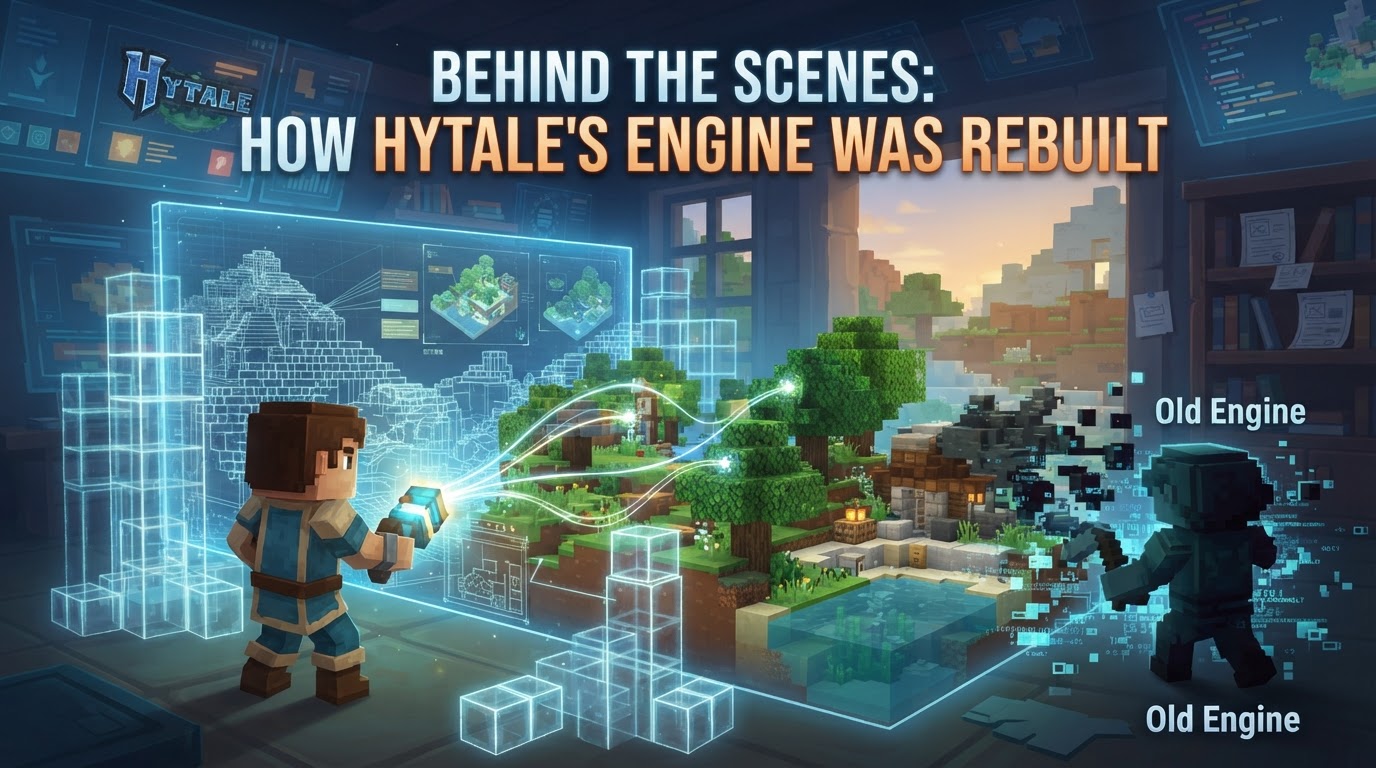
Hytale’s engine development journey is a compelling case study in game development, marked by an ambitious C++ rewrite attempt that ultimately led to a reversion to its original architecture. The game’s current foundation is a refined version of its initial C# client and Java server engine, a decision born from both technical challenges and a desire to preserve the project’s core vision.
Mechanics of the Engine Evolution
Hytale’s engine has undergone a significant transformation, evolving through distinct phases that each presented unique technical and philosophical challenges.
The Legacy Engine: C# Client and Java Server (2015-2020, and 2025-Present)
Initially, Hytale was built upon a proprietary engine featuring a C# client and a Java server architecture. This original configuration, now affectionately referred to as the “Legacy Engine,” was designed from the ground up to be highly customizable, scalable, and deeply moddable. The C# client was responsible for rendering the game world, handling player input, and managing the visual experience. Concurrently, the Java server managed all core game logic, world state, and player interactions. This dual-language approach was particularly strategic, as the Java server backend offered inherent advantages for modding, echoing the robust and community-driven ecosystems seen in other block-based sandbox games. This architecture allowed for extensive server-side modifications and community-driven content, laying the groundwork for Hytale’s promised deep modding capabilities. During this period, the game was reportedly nearing a state of completion, with a distinct “soul” and feel that resonated with its early community.
The C++ Rewrite Attempt (2020-2025)
Following the acquisition of Hypixel Studios by Riot Games, a pivotal strategic decision was made: to undertake an extensive C++ rewrite of the entire engine. The primary motivations behind this monumental undertaking were clear: to achieve superior cross-platform support, particularly for mobile and console platforms, and to leverage the perceived performance benefits and lower-level control that C++ could offer. The vision was to create a unified codebase that would run efficiently and consistently across a wide array of devices. However, this ambitious rewrite faced substantial and ultimately insurmountable challenges. Development was plagued by what was described as “fundamental lag,” indicating deep-seated performance issues that proved difficult to resolve. Furthermore, the project suffered from significant scope creep, as the team found themselves rebuilding systems that had already been functional in the original engine. This period was characterized by a sense of “retreading old ground,” leading to delays and a drain on developer morale. The inherent complexity of rewriting an entire engine from scratch, especially one as intricate as Hytale’s, proved to be a formidable obstacle, ultimately leading to the abandonment of the C++ iteration.
Reversion to the Legacy Engine and “The Merge” (2025-Present)
In late 2025, after the project’s cancellation by Riot Games and the subsequent repurchase of the Hytale intellectual property by its original founders, a critical decision point emerged. The team had to choose between attempting to salvage the unfinished C++ rewrite or returning to the well-established and functional original engine. The choice was made to revert to the 2021-era C# client/Java server architecture – the “Legacy Engine.” This decision was deeply rooted in the realization that “the soul of Hytale was in that original Java/C# codebase,” and that the C++ version, despite its technical ambitions, “felt sterile.” The team recognized the immense value in embracing the established and functional foundation that had already captured the community’s imagination. This reversion allowed the team to capitalize on years of prior development and leverage a known, stable architecture. Crucially, the server backend remains Java 25, a familiar environment for many server administrators, facilitating similar tooling and modding approaches to other popular sandbox games. The final, Herculean effort to prepare for early access involved “The Merge,” where over 300 feature branches that had been dormant since 2021 (encompassing major game systems like advanced combat, farming v2, and Kweebec storylines) were integrated into a single, stable release candidate, bringing the original vision back to life.
Exact Steps in the Engine’s Rebuild and Reversion
The journey of Hytale’s engine development can be broken down into a precise timeline of events:
- 2015-2020: Original Development – Hypixel Studios develops Hytale using a C# client and Java server architecture. The game was reportedly nearing completion during this period, establishing its core mechanics and “soul.”
- 2020: Riot Games Acquisition – Riot Games acquires Hypixel Studios, leading to a significant shift in development strategy and resource allocation.
- 2020-2025: Attempted C++ Rewrite – The development team undertakes a full C++ rewrite of the entire engine. This ambitious project aims for enhanced cross-platform compatibility (mobile, console) and performance. However, it encounters significant technical hurdles, including “fundamental lag” and substantial scope creep, leading to prolonged delays and a feeling of “retreading old ground.”
- June 2025: Project Cancellation – Riot Games cancels the Hytale project, citing escalating development costs and the technical debt accumulated during the C++ engine rewrite. The development team is reportedly let go.
- November 2025: Revival and IP Repurchase – The original founders of Hypixel Studios successfully reacquire the Hytale intellectual property. They face a critical decision: continue with the unfinished and problematic C++ rewrite or revert to the more stable and complete original codebase.
- Late 2025 – Early 2026: Reversion to Legacy Engine and “The Merge” – The founders choose to revert to the 2021-era codebase (the C# client/Java server architecture). In the final weeks leading up to the early access launch, the engineering team executes “The Merge,” a massive effort to integrate over 300 feature branches that had been developed and shelved since 2021. This includes significant content like advanced combat systems, farming v2, and Kweebec storylines, bringing them into a single, stable release candidate.
- January 2026: Early Access Launch – Hytale launches into early access, powered by the original C# client and Java server engine, now incorporating the “300+ merged legacy branches,” marking the successful return and revitalization of the game’s foundational technology.
Tips for Engine Development (Implied from Hytale’s Journey)
The tumultuous path of Hytale’s engine development offers several valuable lessons for game developers:
- Prioritize a “Soulful” Experience over Pure Technical Prowess: The developers’ realization that the C++ version, while technically impressive, “felt sterile” compared to the “soul” of the original Java/C# codebase underscores the importance of maintaining the core vision and feel of a game. Technical superiority should not overshadow the player experience.
- Avoid Overengineering and Scope Creep: The abandonment of the C++ rewrite due to “fundamental lag” and “scope creep” serves as a stark warning. Unnecessary overhauls and expanding project scopes can derail development, regardless of initial technical ambitions. Focus on what is essential and achievable.
- Leverage Existing, Proven Architectures: The successful return to the original C# client/Java server architecture highlights the value of working with a known, functional foundation. Starting from scratch, especially late in development, introduces immense risk and can waste years of prior effort.
- Embrace a Developer-as-First-Customer Philosophy: Hytale’s commitment to a “Hytale within Hytale” approach, where internal modding tools are used to build the base game, is crucial. This ensures that the tools developers use are robust and accessible, directly translating into a powerful and user-friendly modding environment for the community.
Common Mistakes Encountered
Hytale’s engine saga also illustrates several common pitfalls in large-scale game development:
- Late-Stage Engine Rewrite: The decision to rewrite the entire engine in C++ after years of development on a functional system proved to be a massive undertaking. This effectively reset progress across numerous fronts, impacting tools, pipelines, assets, debugging infrastructure, and significantly draining developer morale.
- “Fundamental Lag” and Scope Creep: The C++ rewrite suffered from deep-seated performance issues and an ever-expanding project scope. These are classic challenges that can cripple even well-intentioned development efforts, leading to technical debt and missed deadlines.
- Ignoring the Established Foundation: Abandoning a “potentially close-to-finished game” with a functional engine for a complete rewrite was a detrimental decision. It led to significant delays and ultimately the cancellation of that iteration of the project, demonstrating the risk of discarding proven work.
- Lack of Clear Technical Justification (Uncertain): While motivations like cross-platform support were stated, some community discussions suggested that the necessity for a full C++ rewrite was not always clearly communicated or technically justified, especially given that modern C# can be cross-platform and other solutions might have existed. This ambiguity can lead to speculation and a lack of public confidence.