
Guide
What Is a Hierarchical Finite State Machine? Hytale’s Movement Tech Explained
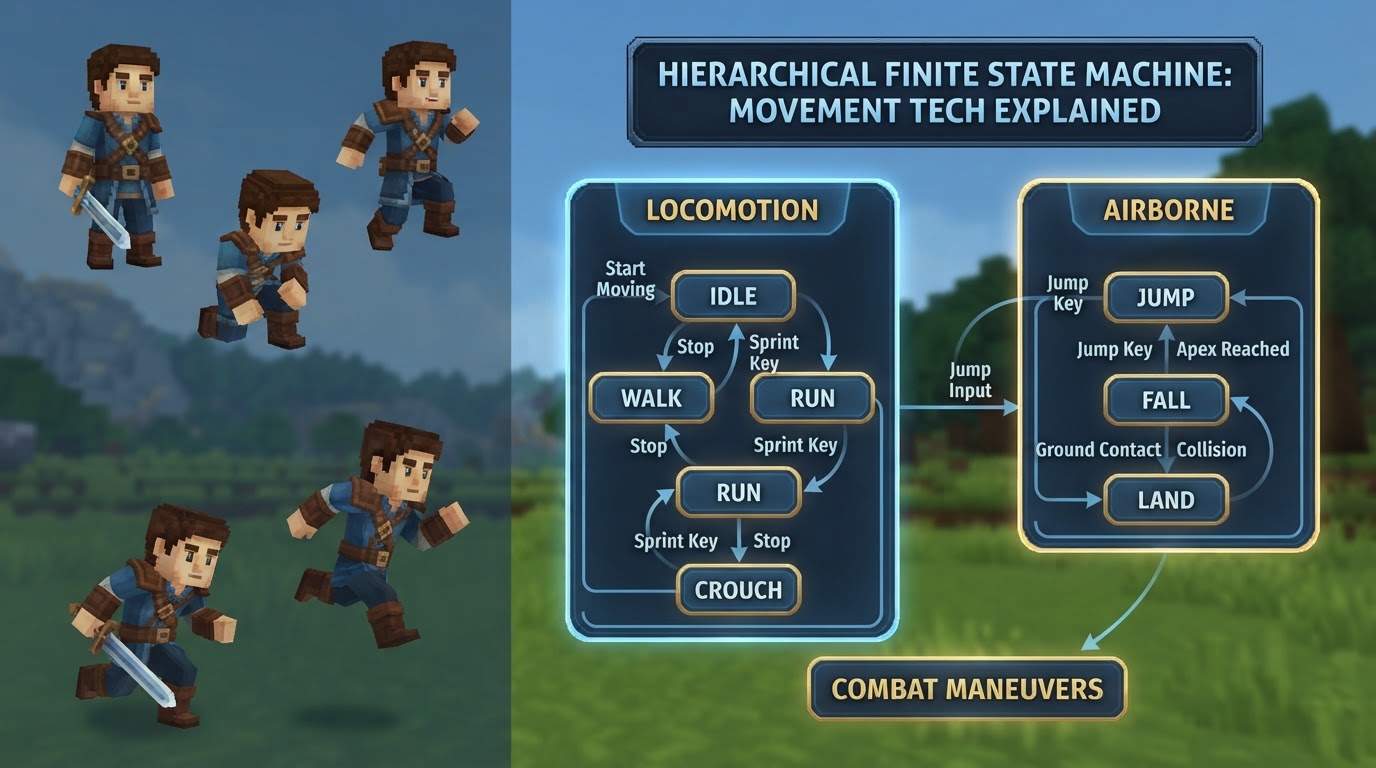
Hytale’s dynamic and intricate movement system, which allows players to fluidly transition between walking, sprinting, crouching, sliding, mantling, and even complex combat maneuvers, is almost certainly powered by a sophisticated Hierarchical Finite State Machine (HFSM). An HFSM is an advanced programming pattern that structures complex behaviors into organized, nested states, making systems like character locomotion robust, extensible, and easier to manage.
What Is a Hierarchical Finite State Machine (HFSM)?
At its core, a Hierarchical Finite State Machine is an extension of a traditional Finite State Machine (FSM). While a standard FSM defines a set of states and transitions between them, an HFSM introduces the concept of hierarchy, allowing states to contain sub-states. This nesting capability is crucial for managing complexity in modern game development, as it enables developers to build intricate systems by breaking them down into logical, manageable layers.
Core Mechanics of an HFSM
- States and Sub-states: The fundamental building blocks. A parent state can encapsulate a set of related behaviors, and its child states represent more specific variations of that behavior. For instance, a top-level “Movement” state might have child states like “GroundMovement” and “AirMovement.” “GroundMovement” could further contain sub-states such as “Idle,” “Walking,” “Sprinting,” “Crouching,” and “Sliding.” This structure allows for a clear organization of behaviors.
- Transitions: These are the rules that dictate when the system moves from one state to another. Transitions are triggered by specific conditions or events (e.g., pressing a jump button, running out of stamina, colliding with an obstacle). A key advantage of HFSMs is that sub-states can inherit transitions from their parent states. If a condition causes an exit from a parent state (e.g., entering water from any ground movement state), all its active child states automatically exit as well, simplifying logic.
- Entry/Exit Actions: Each state can define specific actions that execute precisely when the system enters or exits that state. For example, entering a “Sprinting” state might trigger a sprint animation and increase movement speed, while exiting it might reset speed and play a footstep sound.
- Update Logic: While the system is active in a particular state, that state can execute its own unique update logic. This logic might handle input processing, physics calculations, animation blending, or checking for conditions that would trigger a transition to another state or sub-state.
Hytale’s Movement Tech and HFSM: An Inferred Design
While Hypixel Studios has not explicitly detailed their use of an HFSM for Hytale’s movement, the unofficial documentation referencing a “MovementStatesComponent” that manages a diverse array of states like walking, sprinting, crouching, sliding, mantling, and gliding strongly points towards a state-based architecture. Given the ambition and complexity of Hytale’s movement and combat, an HFSM is the most logical and efficient choice for developers to manage such a system.
Consider the fluidity and responsiveness demonstrated in Hytale’s gameplay trailers and community discussions. Players can transition seamlessly between different movement types, often combining them with combat actions or environmental interactions. This level of sophistication is difficult to achieve with simple, independent scripts. An HFSM allows for:
- Clear Separation of Concerns: Each movement state (e.g., “Sprinting,” “Jumping,” “Gliding”) can encapsulate its own unique logic, animations, and collision rules, preventing code from becoming a tangled mess.
- Reduced Redundancy: Common behaviors or transitions can be defined once in a parent state and inherited by all its children. For example, all “GroundMovement” sub-states might share a common transition to “Jumping” when the jump key is pressed.
- Robustness for Complex Interactions: Hytale features intricate “movement tech” discovered by players, such as “dagger swap tech” or “sword movement tech.” These techniques often involve precise sequences of actions (charging an attack, weapon-swapping, jumping, looking in a specific direction) that manipulate the character’s momentum or state to achieve advanced movement. An HFSM can elegantly manage these complex interactions. A “charging heavy attack” state might have specific sub-states or modifiers that, when combined with a weapon swap event, trigger a unique transition or state modification that bypasses stamina drain while preserving momentum. Similarly, “sword movement tech” likely involves specific conditions within an “Attacking” state that, when met (e.g., specific timing of jump and camera input), transition the player into a high-speed, low-stamina “MomentumBoost” state.
These advanced techniques are not bugs but emergent gameplay possibilities arising from a deeply interconnected and well-defined state system. An HFSM provides the framework for such intricate interactions to be intentionally designed or naturally discovered within the game’s mechanics.
Designing a Movement HFSM: Step-by-Step Approach
Understanding how an HFSM might be structured for Hytale’s movement can be broken down into practical steps:
- Identify Core Movement Categories (Parent States):
- Begin by defining the broadest categories of movement. Examples might include:
Grounded,Airborne,Swimming,Climbing,Interacting(e.g., using a workbench),Combat(e.g., blocking, attacking). - These high-level states provide the primary organizational structure.
- Begin by defining the broadest categories of movement. Examples might include:
- Define Specific Movement Behaviors (Child States):
- For each parent state, break down its behavior into more granular sub-states.
- Under
Grounded:Idle,Walking,Sprinting,Crouching,Sliding,Rolling. - Under
Airborne:Jumping,Falling,Gliding,WallRunning,Mantling. - Under
Combat:Attacking_Light,Attacking_Heavy,Blocking,Dodging.
- Establish Transition Conditions:
- For every possible state change, define the precise conditions that trigger it.
- Example: From
Grounded.WalkingtoAirborne.JumpingwhenJumpKey_Pressed. - Example: From
Grounded.SprintingtoGrounded.SlidingwhenCrouchKey_PressedandIsMovingFast. - Example: From any
Groundedstate toSwimmingwhenIsUnderwater.
- Implement Entry and Exit Actions for Each State:
- Entry Actions: What happens when entering a state? (e.g., play sprint animation, apply sprint speed multiplier, enable gliding physics, equip shield).
- Exit Actions: What happens when leaving a state? (e.g., reset speed to walk, disable gliding physics, unequip shield, stop current animation).
- Develop State-Specific Update Logic:
- Within each state, define what happens on every game frame while that state is active.
Sprintingstate: Calculate movement vector based on input and sprint speed, check for obstacles, check for stamina depletion.Glidingstate: Apply drag, check for collision with ground, manage altitude.
- Handle Hierarchical Inheritance and Overrides:
- Ensure child states inherit common behaviors and transitions from their parents.
- Allow child states to override parent behavior when necessary (e.g., a specific attack animation might temporarily disable general movement input that a parent
Combatstate usually allows).
Tips for Effective HFSM Implementation in Games
- Keep States Focused: Each state should represent a single, distinct behavior. Avoid creating “god states” that try to do too much.
- Clear Transition Conditions: Ambiguous transitions lead to unpredictable behavior. Make conditions precise and mutually exclusive where possible.
- Leverage Inheritance: Utilize the hierarchical nature to share common logic, animations, and transitions among related states, drastically reducing code duplication and maintenance.
- Visualize Your States: For complex systems, drawing state diagrams or using visual debugging tools can be invaluable for understanding the flow and identifying potential issues.
- Implement Debugging Tools: A simple overlay showing the current active state and any recent transitions is incredibly helpful during development and bug fixing.
Common Pitfalls to Avoid
- Overly Complex States: Cramming too much logic into one state defeats the purpose of modularity and makes debugging difficult.
- Undefined Transitions: Forgetting to define transitions for all possible scenarios can leave the system stuck in a state or transitioning unexpectedly.
- Poorly Managed Hierarchy: Not effectively using parent-child relationships can result in a “flat” FSM that doesn’t benefit from the HFSM structure’s advantages.
- Tight Coupling Between States: States that are too dependent on the internal workings of other states become brittle and hard to modify.
- Ignoring Entry/Exit Actions: Forgetting to handle necessary setup (e.g., playing an animation) or cleanup (e.g., resetting a timer) when entering or exiting a state can lead to visual glitches or incorrect game logic.
While the exact technical details of Hytale’s movement system remain proprietary, the principles of Hierarchical Finite State Machines offer a robust and widely adopted solution for managing the kind of rich, dynamic character locomotion that players expect from a modern adventure game like Hytale. Its inferred use underscores the sophisticated engineering behind the game’s immersive world and responsive gameplay.