
Guide
Hytale vs Terraria: Key Differences Explained
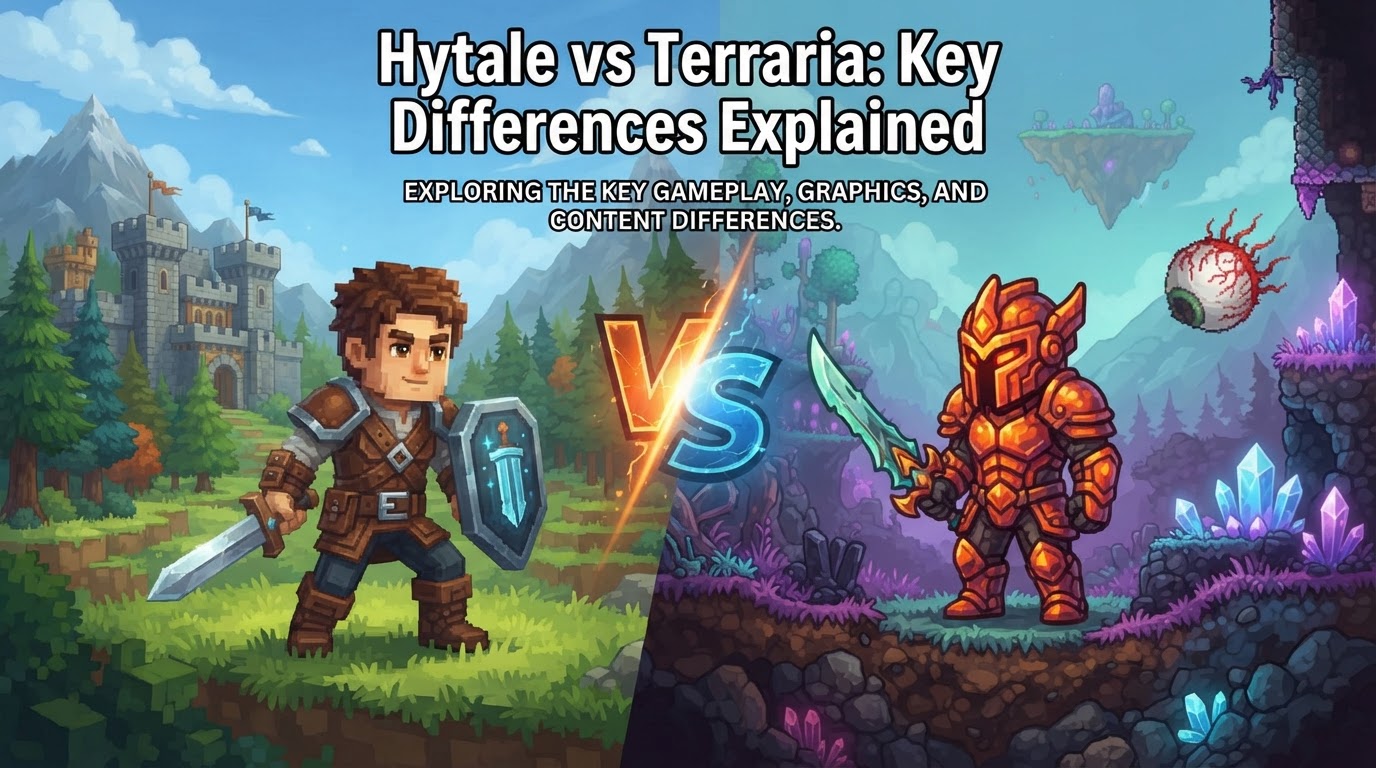
While both Hytale and Terraria offer expansive sandbox experiences, they diverge significantly in their fundamental design, current state, and core mechanics. Hytale, currently in its Early Access phase since January 13, 2026, is a 3D block-based world emphasizing a modding-first approach and a structured RPG progression, whereas Terraria is a fully realized, mature 2D side-scrolling adventure with a rich history of content updates and a robust boss-driven progression system.
Key Differences Explained
Understanding the distinctions between these two titles is crucial for players approaching either game. Hytale aims to blend sandbox creativity with a more defined RPG adventure, while Terraria has perfected the 2D action-adventure sandbox genre.
Dimensionality and Perspective
- Hytale: Features a fully 3D block-based world. This allows for unparalleled verticality, complex environmental designs, and a sense of depth that significantly impacts exploration, combat, and building. Players experience the world from a third-person perspective, navigating intricate landscapes and structures.
- Terraria: Is a 2D side-scrolling game. Its pixel-art aesthetic and flat plane of movement define its gameplay, focusing on horizontal and vertical exploration within a two-dimensional space. This perspective influences everything from combat encounters to base construction, creating a distinct visual and interactive experience.
World Generation and Exploration
- Hytale: Offers procedurally generated 3D worlds, rich with diverse biomes, intricate dungeons, and dynamic NPC settlements. The Early Access “Exploration Mode” is designed around traversing these varied environments, which seamlessly blend sandbox elements with RPG-style discovery. The world feels alive, with different factions and creatures inhabiting distinct zones.
- Terraria: Generates 2D worlds featuring a vast array of biomes, such as Forests, Deserts, Snow, Jungle, the ominous Dungeon, and the corrupting forces of Corruption/Crimson. These worlds also include mini-biomes and micro-biomes, each teeming with unique mobs, blocks, and loot. The entire world loads at once, providing a consistent map, though only nearby blocks are rendered for performance.
Combat System
- Hytale: Aims for an RPG-style combat system with a variety of weapons, each suited for different scenarios. However, Early Access feedback notes a current lack of impact and feedback in combat, inconsistent jumping mechanics, and exploitable enemy AI. The emphasis is on strategic weapon choice to overcome different enemy types and situations.
- Terraria: Features a combat system with a distinct and challenging difficulty curve. It progresses from basic hack-and-slash encounters to requiring significant preparation, specific gear sets, and often custom-built arenas to successfully defeat its numerous, powerful bosses. Mastery of dodging, weapon switching, and potion usage is key.
Building and Creativity
- Hytale: Provides block-based construction with advanced in-game tools and a “Builder’s Workbench” that streamlines material processing. A unique feature is the radial reach of chests, allowing for more integrated and efficient crafting setups where resources are automatically pulled from nearby storage. Players also have the option to claim and renovate existing world structures, offering a different approach to base building.
- Terraria: Offers extensive building freedom with virtually no restrictions on design within its 2D plane. A wide array of tools and accessories, such as the Toolbelt, Toolbox, and Brick Layer, are available to enhance building efficiency and complexity. Planning builds to integrate both aesthetic appeal and functional elements (like NPC housing or boss arenas) is a core aspect of the game.
Modding Support
- Hytale: Was designed with a “modding-first” architecture from the ground up, providing extensive support even in its Early Access phase. This includes server plugins (written in Java), highly customizable data assets (using JSON for blocks, items, NPCs, and world generation), art assets, and powerful in-game creation tools like an Asset Editor and World Tools. This integrated approach aims to empower creators directly.
- Terraria: Possesses a vast and incredibly mature modding community. Over many years, this community has significantly expanded the game’s content, added new mechanics, and prolonged its longevity well beyond its official updates. While not built with modding as its primary architectural focus, the community-driven tools have proven immensely powerful.
Progression and RPG Elements
- Hytale: In its current “Exploration Mode,” includes core RPG elements such as health, stamina, and survival systems, alongside progression mechanics tied to exploration and crafting. However, some Early Access feedback suggests that too many advanced mechanics are initially available, which can dilute the sense of character growth and the challenge of unlocking new abilities. The full, story-driven “Adventure Mode” is planned for a later update, promising a more structured narrative experience.
- Terraria: Offers a clear, challenging, and deeply satisfying progression system. This is largely driven by defeating a sequence of bosses, exploring increasingly dangerous biomes, and constantly upgrading gear, weapons, and accessories. The game’s progression is a core part of its identity, pushing players to continuously improve and adapt.
Exact Steps / Tips
Hytale (Early Access)
- Prioritize Teleporters: Set up teleporters early in your playthrough. This is crucial for efficient travel between biomes and to avoid time-consuming backtracking, especially when exploring far from your base.
- Strategic Combat: Always choose your weapons based on the enemy types and combat situations you encounter. Faster weapons like swords or daggers are generally more effective against quick, agile enemies, while heavier weapons might be better for slower, tankier foes.
- Early Resource Focus: Begin by gathering essential resources such as sticks, plant fibers, and rubble. These are vital for basic tool crafting using the convenient pocket crafting menu, allowing you to quickly get started.
- Progressive Upgrades: Make sure to upgrade your weapons, armor, and tools consistently before venturing into new, more difficult regions. Pay close attention to the strength and behavior of enemies in an area as a clear signal for when your gear needs an upgrade.
- Engage with NPCs: Take the time to talk to non-player characters. They often provide valuable guidance, objectives, and insights into the game’s mechanics and lore.
- Base Planning: When building your base, plan the layout to maximize the radial reach of your workbenches to nearby chests. This creates a highly efficient crafting setup where materials are easily accessible. Consider renovating existing in-world structures initially rather than building a large base from scratch.
- Optimize Settings: Adjust game settings and keybinds to suit your personal playstyle. Tailoring these can significantly improve your combat performance and overall movement fluidity.
Terraria
- Consult the Guide: Always utilize the Guide NPC. By showing him any item, he can reveal all crafting recipes that item is used in, which is invaluable for progression.
- Build Valid Housing: Construct proper housing (requiring walls, a door, a table, a chair, and a light source) to attract NPCs. Each NPC provides unique services, such as selling items, healing, or giving advice.
- Gear Up for Bosses: Before attempting any boss fight, always upgrade your armor (e.g., from wood to gold or platinum) and weapons to the best available. Additionally, build a dedicated arena, often a long platform with campfires for health regeneration, to give you an advantage.
- Paced Progression: Terraria is a journey, not a race. Take your time to explore, build, and gather resources. Avoid rushing through early bosses to Hardmode without adequate preparation, as this can lead to overwhelming difficulty.
- Utilize Building Tools: Acquire and effectively use building tools and accessories like the Toolbelt or Brick Layer. These items can significantly speed up and improve the complexity and efficiency of your building projects.
- Organize Storage: Implement an effective inventory management system by utilizing chests for storage. Labeling chests or organizing them by item type will save you a lot of time in the long run.
Common Mistakes
Hytale (Early Access)
- Neglecting Teleporters: Not setting up teleporters early can lead to frustrating and time-consuming travel across the large 3D world, hindering efficient exploration and resource gathering.
- Suboptimal Weapon Choices: Using weapons that are not well-suited for the specific combat situation or enemy type can make fights unnecessarily difficult and resource-intensive.
- Unplanned Resource Gathering: Collecting resources without a clear objective or purpose can lead to wasted time and inefficient progress, as your inventory fills with unneeded items.
- Poor Stamina Management: Running out of stamina during critical moments, such as combat or escaping dangerous situations, can be detrimental and often lead to defeat.
- Ignoring Progression Structure: Treating Hytale as completely unstructured and rushing into high-difficulty areas without proper upgrades or understanding the mechanics will likely result in a frustrating experience.
- Skipping NPCs/Dialogue: Missing out on crucial guidance, objectives, and lore by not interacting with non-player characters can leave you feeling lost or unaware of key game features.
- Premature Large Base Building: Committing to a large, permanent base too early before understanding the map layout or optimal strategic locations can lead to regret and the need to relocate later.
- Lack of Combat Feedback: Experiencing vague movement and combat that lacks impactful feedback, as noted in Early Access, can potentially lead to player frustration and a feeling of disconnect.
- Undermined Progression: A feeling that advanced mechanics are given to the player too early can make the sense of character progression and the achievement of unlocking new abilities less meaningful.
Terraria
- Ignoring the Guide & Housing: Overlooking the Guide NPC’s utility for crafting recipes and failing to build valid housing for other NPCs makes early survival and progression significantly harder due to lack of services.
- Unprepared Boss Fights: Engaging bosses without proper gear, a well-designed arena, or a solid understanding of their mechanics is a common mistake. Activating boss-summoning items without readiness almost guarantees defeat.
- Rushing Progression: Attempting to advance too quickly, especially into Hardmode, with insufficient gear or preparation, will lead to overwhelming difficulty and a very frustrating experience.
- Treating it like Minecraft: New players sometimes expect a similar gameplay loop to Minecraft. This can lead to neglecting Terraria’s unique progression, intricate combat system, and essential accessory mechanics.
- Skipping Recipes: Not utilizing the Guide NPC to discover crafting recipes for essential items means players often miss out on powerful tools, weapons, and utility items.
- Lack of Hardmode Preparation: Failing to adequately prepare for the significant increase in difficulty, the spread of corruption/crimson, and the introduction of new, tougher enemies that occur when entering Hardmode.
Uncertainties
Given Hytale’s Early Access status, several aspects remain subject to significant change and future development:
- Hytale’s “Adventure Mode”: The full, story-driven “Adventure Mode,” which promises scripted narratives, cutscenes, and a definitive conclusion, is not yet available in Early Access. Its eventual implementation and how it will compare to Terraria’s more open-ended, boss-driven progression remain to be seen.
- Hytale’s Polished State: Hypixel Studios has been transparent that the Early Access version is “raw and broken” and “isn’t good yet,” emphasizing that it’s a foundation for future development. Therefore, many of Hytale’s mechanics, the overall player experience, and the level of polish are subject to significant change and improvement as development continues.
- Long-Term Content: While Hytale has regular updates planned, the breadth and depth of its endgame content in comparison to Terraria’s extensive post-Moon Lord offerings and years of content updates are still unknown. The longevity and replayability of Hytale’s future content will be a key factor.