
Guide
Hytale Farming and Food System: Complete Guide
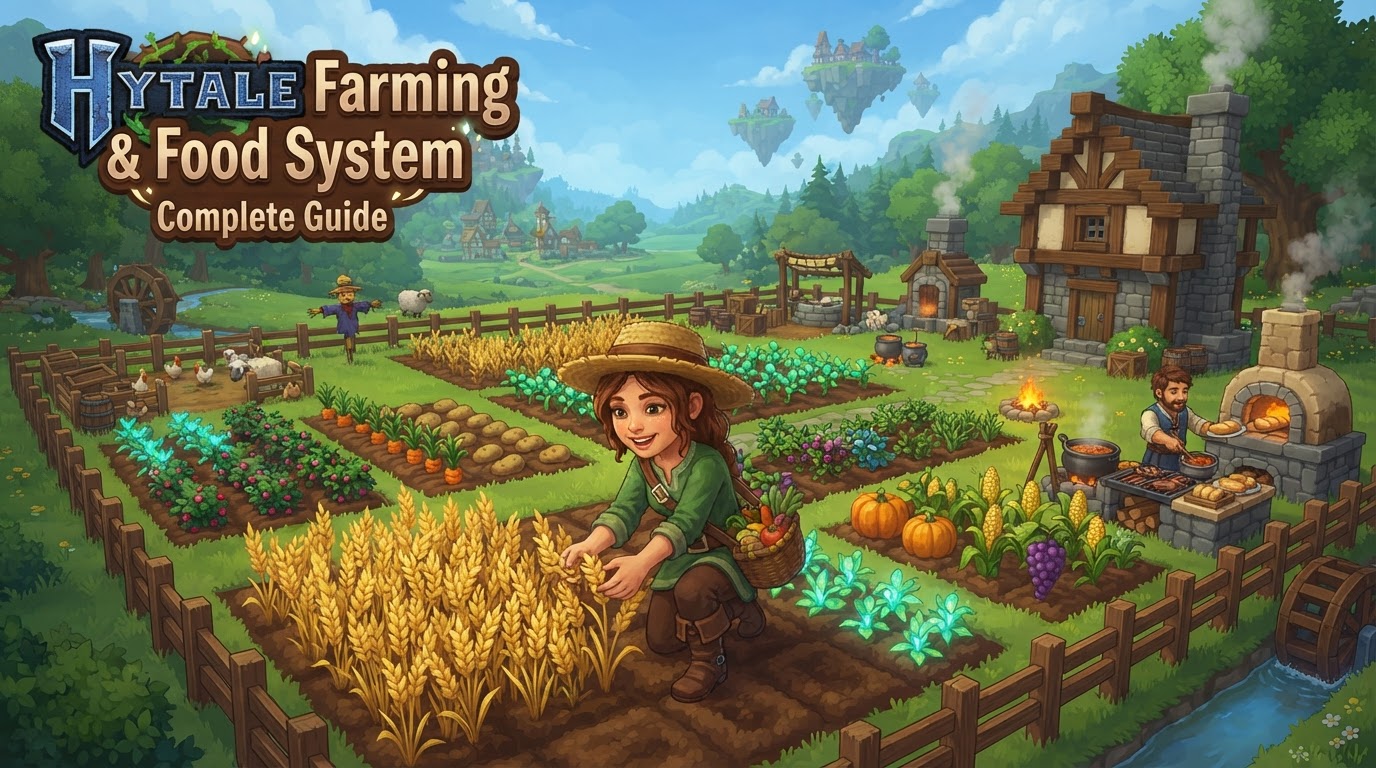
Hytale’s farming and food systems offer a distinct approach compared to many survival games, focusing on progression, resource management, and strategic buffs rather than a traditional hunger system. Players will engage with a deep agricultural system to grow a wide variety of crops and utilize a cooking system that provides temporary, impactful benefits for exploration and combat.
Hytale Farming System
Farming in Hytale is a foundational activity for resource gathering and progression. It involves preparing soil, planting diverse crops, and managing their growth with various tools and environmental factors. The system rewards careful planning and offers significant benefits as you advance.
Exact Steps for Basic Farming
To begin your farming journey in Hytale, follow these essential steps:
- Craft a Farmer’s Workbench: This is your primary crafting station for all farming-related items. It requires 6x Tree Logs (any type) and 20x Plant Fibers (obtained by harvesting bushes or tall grass).
- Craft Tools: You will need a Crude Hoe to prepare your land and a Watering Can to significantly boost crop growth.
- Acquire Initial Essence of Life: Before you can purchase seeds, you need Essence of Life. Harvest wild crops using Shears to gather your first few units of this vital resource.
- Buy Seeds: Interact with your Farmer’s Workbench and navigate to the “Seeds” tab. Use your Essence of Life to purchase initial seeds, such as Wheat or Cabbage seeds, which typically cost 2 Essence each at Tier 1.
- Till Soil: Equip your Crude Hoe and use it on dirt or grass blocks. This will transform them into darker, tilled soil, making them ready for planting.
- Plant Seeds: Equip the seed bag you purchased and right-click on the tilled soil to plant your seeds. Each click plants one seed.
- Water Crops: Fill your Watering Can at a water source and then use it on each planted tile. Watering crops dramatically accelerates their growth rate, making it a highly recommended step.
- Wait and Harvest: Allow your crops to mature. Once fully grown, you can harvest them by pressing the ‘F’ key. You can continuously harvest by holding ‘F’ and moving through your field.
Tips for Farming
- Workbench Proximity: Place a storage chest within six blocks of your Farmer’s Workbench. The workbench can automatically pull necessary items directly from nearby chests, streamlining your crafting process.
- Efficient Watering: The Watering Can is indispensable. Using it makes crops grow approximately 2.5 times faster, significantly reducing wait times.
- Optimal Layout: Design your farm with rectangular rows or grids. This layout makes watering and harvesting more efficient, especially when using the continuous harvest feature.
- Crop Protection: Build fences around your agricultural plots to protect them from hostile mobs. Scarecrows can also be placed within fields, suggesting they may deter certain creatures from damaging your crops.
- Mushroom Farming: Certain mushroom types, such as blue flatcap, blue common, redcap, and green flatcap, can be placed to multiply nearby, offering another source of renewable resources.
- Essence of Life Generation: In the early game, focus on gathering wild crops for Essence of Life. As your farm grows, you can convert surplus crops into Essence of Life at the Farmer’s Workbench, with onions, potatoes, pumpkins, and aubergines being noted as good sources.
- Eternal Seeds: Look out for eternal seeds, identifiable by a green seed bag icon. Plants grown from these seeds automatically regrow after harvesting, eliminating the need for replanting. Eternal seed packs can sometimes drop when harvesting normal crops.
- Fertilizer Use: Animal “poop” can be used as fertilizer to further boost crop growth, adding another layer to farm management.
Common Mistakes/Uncertainties in Farming
- Animal Despawning/Mob Interaction: There are community observations suggesting that animals kept in pens may despawn or be killed by hostile mobs like wolves and foxes, even within enclosed spaces. While fences help, the exact conditions for these interactions are not fully official or confirmed.
- Feedbag Effectiveness: The effectiveness of feedbags for animal husbandry is currently uncertain, with some players reporting inconsistent results.
- Soil Effects: While “soil quality” is mentioned as influencing crop growth, the exact mechanics of different soil types on water retention and growth rates are not yet fully detailed.
Hytale Food System
Hytale’s food system is not about managing a hunger bar, but rather about strategic consumption. Eating food restores health and provides temporary buffs that can significantly aid players in various activities, from combat to exploration. Cooking raw ingredients enhances these benefits.
Exact Steps for Food Preparation
To make the most of your harvested ingredients, follow these steps for food preparation:
- Obtain Ingredients: Gather raw ingredients through farming, hunting animals, or foraging in the wild.
- Basic Cooking (Campfire):
- Craft a Campfire: This requires 4x Sticks and 2x Gravel.
- Place and Fuel: Place the Campfire on the ground and add fuel (logs are more efficient than sticks).
- Cook Item: Place a single raw item (e.g., raw meat, fish, or a vegetable) into the Campfire’s food slot.
- Wait: The item will cook over time, transforming into a cooked version with improved benefits.
- Advanced Cooking (Cooking Station/Chef’s Stove):
- Craft the Station: Craft a Cooking Station or Chef’s Stove, which typically requires 2x Copper Ingots, 10x Logs, and 5x Stone.
- Access Menus: Interact with the station to open its cooking interface. This usually includes tabs for cooking, baking, and ingredient crafting.
- Combine Ingredients: Follow recipes to combine multiple ingredients. Advanced dishes provide stronger health boosts and longer-lasting buffs than simple cooked items.
- Eating Food: Place the prepared food item into your hotbar. Equip it, then hold down the right mouse button until the eating animation completes to consume the food and gain its benefits.
Tips for Food System
- Prioritize Cooked Food: Always aim to cook your ingredients. Cooked and prepared dishes offer superior health restoration and more potent, longer-lasting buffs compared to raw items.
- Strategic Buffs: Choose your meals wisely based on your current activities. Some foods might provide enhanced combat abilities, while others could boost stamina for exploration or resource gathering.
- Top-Tier Meals: Recipes like Meat Pie and Pumpkin Pie are noted as excellent late-game food options, offering strong healing and valuable buffs.
- Unlock Recipes: Engage with Rootling Merchants, found in Kweebec villages or the Forgotten Temple. They trade new cooking recipes for Essence of Life, and their stock rotates, so check back often to expand your culinary options.
- No Infinite Water: Be mindful that Hytale currently lacks an infinite water source. This means that recipes requiring water (like bread) can be resource-intensive and may deplete natural water bodies if not managed carefully.
Common Mistakes/Uncertainties in Food System
- Hunger Bar Absence: The game currently does not feature a traditional hunger bar. Players familiar with other survival games might initially expect one, but Hytale’s system focuses purely on health restoration and temporary buffs, similar to games like Valheim.
- “Work in Progress”: The cooking system is explicitly stated to be a “work in progress” by the developers. This means that current recipes, mechanics, and available dishes may change or expand significantly before or during the game’s official release.
- Complete Recipe List: While many recipes are mentioned (e.g., various pies, skewers, salads), a comprehensive and definitive list with all ingredients and precise effects for every dish is not yet publicly available or confirmed to be final.